The Slow, Joyful Return of Split-Screen in LEGO Fortnite
LEGO Fortnite split-screen local co-op evolved from buggy 2024 to polished 2026, delivering dynamic couch multiplayer.
I remember sitting on my couch in late 2024, controller in hand, staring at the TV as the State of Play announcement rolled. The moment the LEGO Fortnite split-screen trailer hit the screen, something stirred deep in my gaming soul—like hearing your favorite childhood tune after years of silence. Back then, the feature was promised for October, and man, it couldn’t come soon enough. Fast forward to 2026, and split-screen is no longer a distant dream; it’s as natural as the bricks themselves. But the journey here has been anything but straightforward, and every time I hear that classic split-screen \u201cwhoosh\u201d when a second player joins, I can\u2019t help but smile at the quiet rebellion it represents.
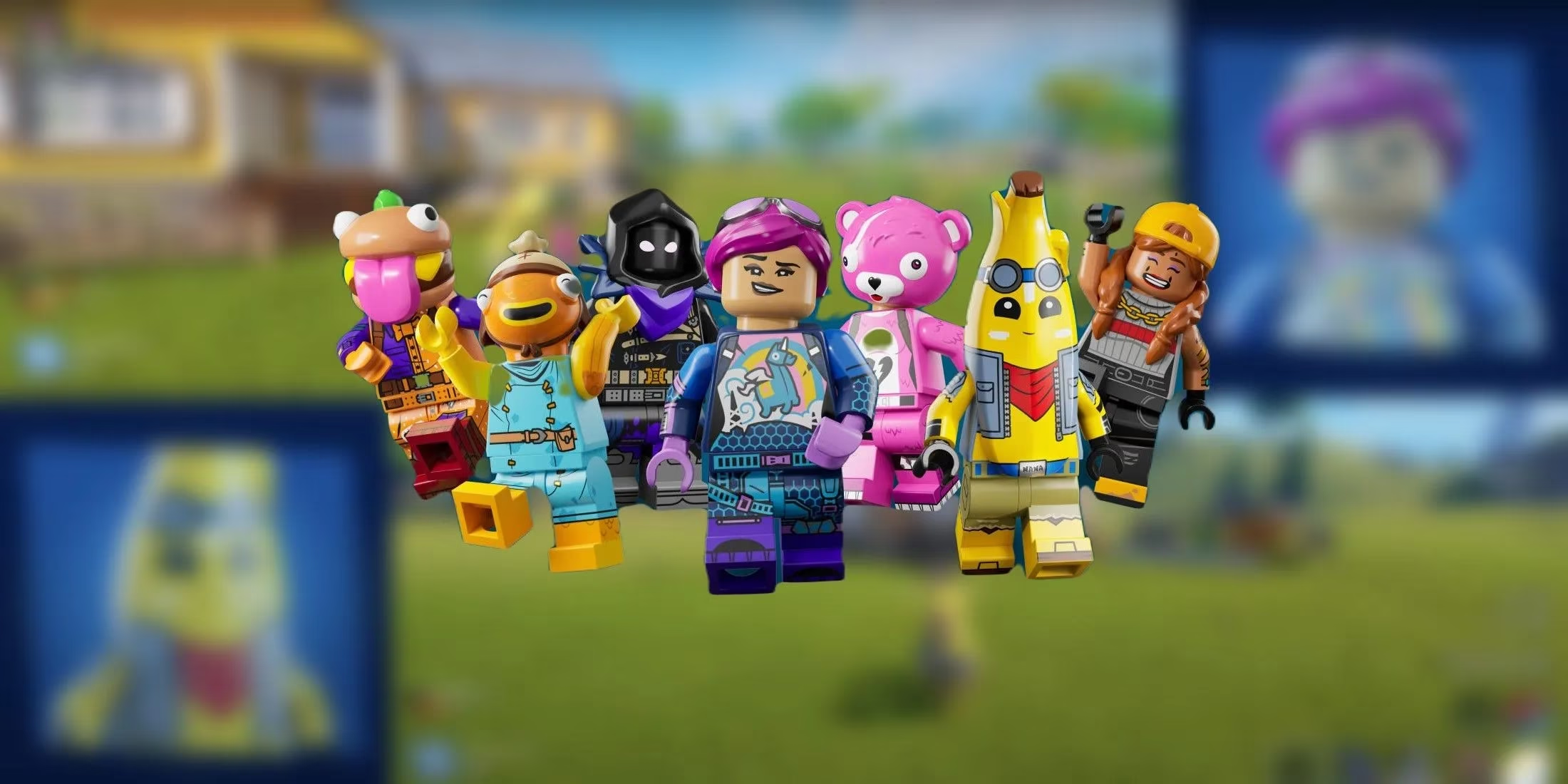
When I was growing up, local co-op wasn\u2019t just a feature—it was the DNA of LEGO games. Traveler\u2019s Tales\u2019 titles like LEGO Star Wars: The Complete Saga and LEGO Batman taught me the ropes of gaming right alongside my older sister. Those games understood that a second player didn\u2019t need a grand narrative reason to exist; they just needed to be there, ready to jump in as Robin or a silent Jedi. The Emperor\u2019s throne room fight in The Complete Saga? I still remember the shock of realizing both Luke and Darth Vader were playable simultaneously, a tiny design miracle that made couch co-op feel essential. So when LEGO Fortnite launched in 2023 without split-screen, it felt like a piece of my past had been tucked away in a dusty attic.
The initial omission wasn\u2019t just an oversight; it was emblematic of a wider shift. By 2024, the industry had grown weirdly comfortable treating local multiplayer as a novelty rather than a standard. Encouraging players to each buy a separate console, a separate subscription, and their own battle pass just made more financial sense than letting two people share a screen. I get it, let\u2019s be real—the economics are brutal. But for those of us who grew up passing a controller back and forth, the loss was palpable. When Epic finally added split-screen to LEGO Fortnite in October 2024, it felt like a muscle memory triggered after years of numbness. It wasn\u2019t perfect, of course. Early days were plagued with the kind of bugs that make you laugh and cry at the same time: UI elements would overlap into a mess of numbers, and occasionally one player\u2019s build mode would completely devour the other\u2019s inventory. Yet, we didn\u2019t care. My best friend and I spent a whole weekend building a village that collapsed into itself because we both tried to edit the same wall at the same time. \u2026It was gloriously chaotic.
Fast forward to 2026, and the experience has matured like a fine vintage. After half a dozen major updates, the split-screen mode now feels as sturdy as a well-locked brick. Dynamic screen merging\u2014when players wander close together the screens seamlessly blend into one full view\u2014became a thing in late 2025, and honestly, it\u2019s the kind of magic I didn\u2019t think we\u2019d ever get. The bug-fixing patches from 2025 also smoothed out the infamous \u201cplayer two freeze\u201d when entering caves, and local audio now correctly isolates each player\u2019s actions. Even the Switch version, which struggled early on, runs a stable 30fps in splitscreen, a testament to some serious optimization sorcery. And you know what\u2019s quietly poetic? The community started hosting \u201ccouch co-op Sundays,\u201d where families and roommates share their split-screen creations online, echoing the sleepover culture of the late 2000s. My nephew, who\u2019s seven, learned how to craft his first glider while sitting next to me, his tiny fingers mirroring my movements on the second controller. That moment\u2014teaching him the very layout of Gotham City\u2019s docks, now reimagined in Fortnite\u2019s blocky universe\u2014brought me right back to my own childhood.
LEGO Fortnite\u2019s split-screen story isn\u2019t just a technical feature log; it\u2019s a reminder that some experiences refuse to die. Yes, the gaming industry will always chase the shiny, the online, the subscription-driven. But the stubborn persistence of a second player sitting right next to you, sharing the same screen, building the same castle? That\u2019s a form of resistance. It\u2019s a statement that fun doesn\u2019t always need a server, and that laughter echoing in the same room can\u2019t be replicated by a headset. In 2026, I watch games like LEGO Horizon Adventures and LEGO 2K Drive continue to carry the torch, but it\u2019s the late bloomer, LEGO Fortnite, that feels most like a homecoming. Every time that screen splits, I\u2019m reminded that even in an era of digital distance, the oldest magic\u2014sitting shoulder to shoulder\u2014still holds its power. And hey, if I crash our shared hover platform because I\u2019m distracted by my brother\u2019s terrible puns, well, that\u2019s just part of the recipe.