I Drift Through Brick Bay: How LEGO Fortnite’s Social Sim Captured My Imagination
In LEGO Fortnite's Brick Life, a social sim meets creative roleplay, letting players live out brick-city lives through jobs, decorating, and community.
I still remember the first time my minifigure stepped off the bus and into Brick Bay. The sky glowed a perfect plastic blue, striped by clouds that looked like they’d been snapped straight from a baseplate, and everywhere I looked, the hum of tiny brick lives filled the air. A hot dog vendor waved from a sidewalk studded with 1x1 plates. A car shaped like a dragon rumbled past, its driver a pirate-hatted figure with a parrot perched on her shoulder. Someone had built a rooftop garden out of translucent cheese slopes, and a group of astronauts were having a dance-off outside the bank. In that moment, I understood: this wasn’t just another Fortnite mode. It was a living city where every stud had a story.
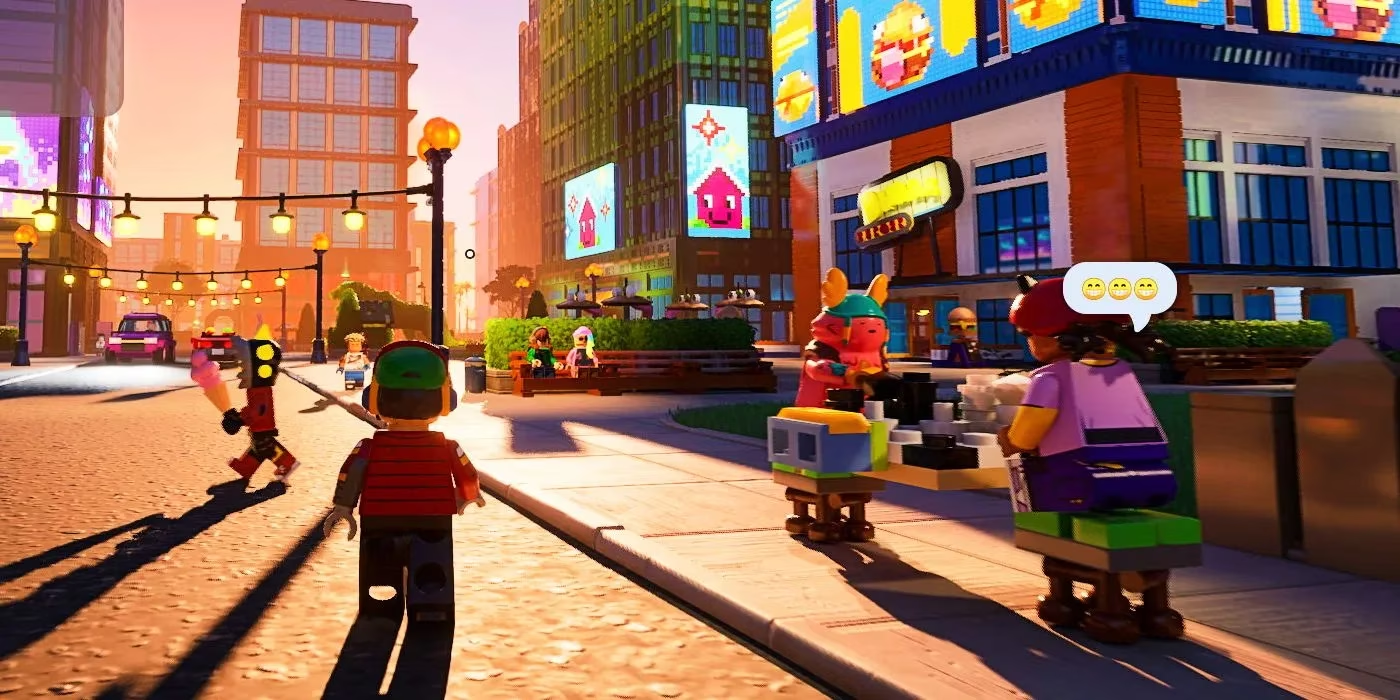
By 2026, Brick Life has quietly become my daily refuge. Born in late 2024 as a 32‑player social sim inside LEGO Fortnite, it promised a cross between GTA Online roleplaying and LEGO City Undercover, and it has delivered on that vision in ways that still make me smile. I can choose a job—mixologist, courier, firefighter, hairstylist, even a pirate-tooth sharpener (yes, that’s a real thing)—and clock in each day alongside strangers who become friends through the simplest of gestures. A text chat bubble floats above our heads, and because every server caps at 32, the city feels bustling but never overwhelming. I learned the rhythm of Brick Bay: morning rush at the docks, afternoon hangouts at the beach, evening open‑mic at the comedy club where our avatars try out build‑your‑own punchlines.
My apartment is my sanctuary. I’ve decorated it with furniture earned through honest work—a rainbow bed I traded five delivered pizzas for, a bookshelf that actually displays tiny leather‑bound bricks, a neon “Chill” sign I won at a weekend fishing tournament. I park my ice‑cream truck (yes, I drive an ice‑cream truck) in the garage of my pastel‑yellow townhouse, and sometimes I just sit on the balcony, watching the streetlights flicker on as another player’s convertible zooms by, its horn playing the Fortnite default dance tune. It’s roleplay reduced to its purest joy: no K/D ratio, no storm, just the gentle art of pretending to be a LEGO citizen.
Yet what strikes me most is how this city has bridged generations. I see kids building forts in the park with their pixelated blocks, parents—identifiable by their “joined in 2017” back bling—taking on the role of mayors or schoolteachers, and whole groups coordinating via whisper chat to throw surprise birthday parties for someone’s rental llama. The safety is deliberate: chat filters block personal info and strong language, making parents breathe easier. On Reddit, one user put it perfectly: “My 8‑year‑old is learning to negotiate a salary and pay rent, and I can’t even be mad.”
Of course, the community has always been part of the magic. When Brick Life first dropped, comparisons erupted: some called it the spiritual successor to PlayStation Home, others saw it as the antidote to GTA 6 anticipation, and a nostalgic few whispered “LEGO City Undercover meets the Metaverse.” But two years later, it has become its own creature—a place where a pirate and a princess can co‑own a food truck, where a 12‑year old and a retired teacher can debate the best roof tile shape for a brutalist skyscraper, and where the most competitive moment of the day is a fishing contest with a rubber duck as the trophy.
If you had told me in 2017 that I’d spend my evenings in a digital LEGO city, working as a part‑time DJ and customizing my couch, I would have laughed over my SCAR. Back then Fortnite was a storm, a battle bus, and a desperate scramble for shields. Now it’s a platform—an ever‑expanding galaxy that holds Battle Royale, LEGO Fortnite Odyssey with its new bosses and progression revamp, the 5v5 tactical shooter Ballistic, rhythm stages in Jam, and the nostalgic loop of OG. But Brick Life feels different. It’s the heartbeat of the platform’s softer side, proof that a game can grow up and settle down without losing its soul.
Looking ahead, I can only imagine what’s next. Rumors swirl of a waterfront expansion where we’ll be able to pilot brick‑built sailboats, and dataminers whisper about a museum where players can display their own custom builds. But for now, I’m content. Every day I log in, I’m not chasing a crown; I’m chasing a small, quiet story. Maybe I’ll deliver a package to the lighthouse keeper, or help a new player find the hidden rooftop slide, or simply sit in the plaza and watch the parade of infinite imagination. In Brick Bay, the sun never sets on possibility. The blocks are in our hands. And I, for one, am happy to keep building.
🌟 Fortnite has become less a game and more a universe—and in that universe, the smallest brick can support the largest dream.