Godzilla's Siege and Kong's Reckoning: The Monstrous Metamorphosis of Fortnite's Chapter 6
Epic Games' Fortnite Chapter 6 Season 1 Godzilla crossover shattered the game and ignited a King Kong rumor frenzy.
It was the shudder heard across every connected screen on the globe. When the colossal shadow of Godzilla first stretched across the neon-drenched, pagoda-studded landscape of Fortnite’s Chapter 6, Season 1, the very architecture of competitive gaming buckled. The year was 2025, and Epic Games had not merely added a skin—they had surgically implanted a myth onto the Island. The result was nothing short of a cultural detonation that sent shockwaves roaring through the entire player base, leaving a trail of shattered expectations and fried graphics cards in its wake.
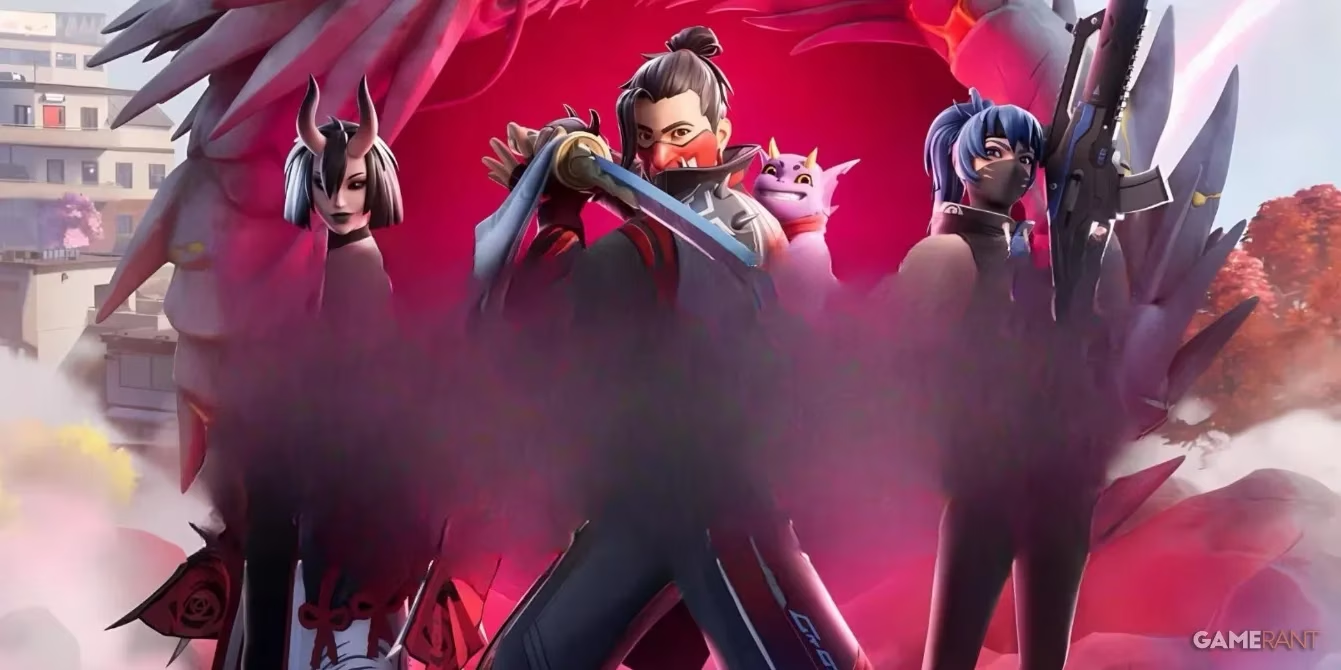
The evolution of Fortnite's cosmetic ecosystem had already been pushing boundaries, with drops like the huggable Baymax from Big Hero 6 warming hearts, but the Godzilla Evolved skin, lurking on that elusive bonus page of the Battle Pass, was a different beast entirely. Players didn't just claim this outfit; they endured a spiritual trial for it. The countdown to January 17, 2025, at 9 AM ET was not measured in days or hours—it was measured in the frantic, sweat-soaked grinding of millions of thumbs across controllers and touchscreens. When the lock finally shattered, a cacophony of atomic breaths set servers ablaze. Suddenly, the meticulously crafted Japanese-inspired map, with its floating torii gates and cherry blossom breezes, became a stomping ground for the King of the Monsters. Entire squads were wiped not by conventional gunfire, but by the sheer psychological terror of hearing those iconic, spine-rattling footsteps thundering from behind a mountain.
The integration was so breathtakingly seamless, it felt less like a crossover and more like a homecoming. Godzilla, after all, is not just a monster; he is a radioactive allegory, a living seismic event born from the silver screen of 1954 and weaponized by modern gaming. To witness a skyscraper-sized dorsal plate slice through the morning fog while a player performed the griddy on a downed opponent was to see the apex of absurdist entertainment. Epic Games had caught lightning in a bottle, and the storm was only just beginning to gather. The collaboration didn’t just set a high bar for the rest of 2025—it rocketed that bar straight into orbit, leaving the developers with the Herculean task of topping the untopable.
And yet, the Island whispers. The data-miners, those digital archaeologists of the deep code, began picking at the seams of reality shortly after Godzilla’s debut. The legendary leaker ShiinaBR sent the community into a fresh spiral of mass hysteria with murmurs of a second titan. The rumor mill churned out a prophecy: King Kong was next. Speculation mutated into a frenzy. Was Epic Games truly mad enough to orchestrate a live-action rematch of Godzilla x Kong: The New Empire within the confines of a 100-player battle royale? The sheer, unadulterated hubris of it was magnificent. For months, the game oscillated between tranquil looting and the paranoid search for a giant ape hiding in the cumulus clouds.
Then, without warning, the skies darkened permanently. The 2025 mid-year event didn't just introduce a new point of interest—it broke the island in half. A giant, fur-covered fist erupted from the chasm, and King Kong joined the fray, not as a simple costume, but as a world-altering NPC presence whose chest-beating roar could be heard across the map. The collision of these two IP giants transformed Fortnite from a game into a full-throttle cinematic simulator. One minute, a player could be scaling Kong’s back to harvest resources; the next, they could be vaporized by a Godzilla heat ray that carved a canyon through Tilted Towers. It was chaos orchestrated with a conductor's precision.
The 2026 landscape owes its entire meta-philosophy to that January 2025 launch. Skin sales didn’t just climb; they exploded with the force of a supernova. The introduction of the Kicks cosmetic line suddenly looked quaint—why worry about the sneakers on your character’s feet when you were busy piloting a 50,000-ton reptile that made the ground liquefy with every gulp of radiation? The studio had effectively solved the "power fantasy" equation by letting the players become the environmental hazard. It was a masterclass in audience capture, proving that nostalgia, when paired with destructible environments, is the most potent currency in the universe.
To look back at the history of Chapter 6 is to witness a timeline of escalation. The seasonal narrative, steeped in Japanese aesthetics, provided a beautiful canvas for the kaiju warfare. The original characters, the samurai warriors, and the futuristic technology all paled in comparison to the apex predators. The map itself had to be re-engineered multiple times just to survive the onslaught. Builds that once offered sanctuary became toothpick prisons to be swatted aside by Kong’s massive hand. Strategy shifted from watching the horizon for snipers to listening for the atmospheric pressure drop that signified a charged atomic breath. It was an era where the phrase "git gud" became synonymous with "dodge the skyscraper-sized lizard."
Epic Games has never been a company to rest on its laurels, but the arrival of Godzilla and Kong created a monster problem of their own design. How do you follow a cataclysm? The leaks of 2026 suggest they are going to throw the entire cinematic universe playbook at the wall. The very code of Fortnite seems to groan under the weight of its own infinite possibilities. Yet, for the veterans who stood on those digital beaches in January 2025, watching the green atomic light crest the horizon for the first time, nothing will ever compare to the moment the battle royale genre grew wings, scales, and a monstrous appetite for destruction. It wasn't just a new chapter; it was the final, definitive proof that Fortnite had stopped being a game. It had become a god.